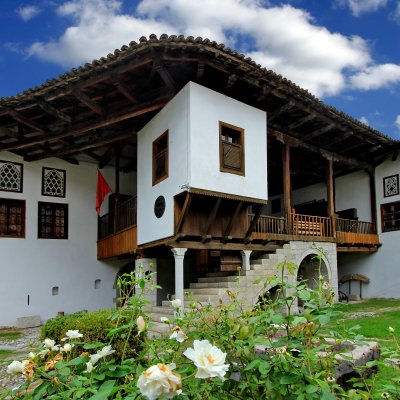
Shkoder History Museum Shkodër
Rruga Oso Kuka 32
Shkodër Shkodër
Albania
muzeuhistorikshkoder.org/?lang=en
Are you the owner of this business?
Suggest an edit
Museums, Museum


Shkoder History Museum Shkodër
DETAILS
History (Area)
The Historical Museum of Shkodra began to be organized in 1947 (under the name "People's Museum"), but took full shape in 1949.
(Point)
Internal Albanian trade in the 18th century followed the path of forming large interprovincial markets, through the strengthening of craft-commercial centers and smaller local markets. In this period, Shkodra began to develop greatly, turning into a true craft-commercial metropolis in the region and beyond. In Shkodër, metal was worked for the production of weapons, work tools and household furniture. Shkodra was known for the production of bells and blacksmiths (ferrarii), who, apart from Shkodra, could be found more or less in every city in Albania. In the museum, wooden furniture with carvings such as shelves, tables, chairs, decorative elements of the interior of apartments, with motifs are exhibited. geometric, floral and zoomorphic. In total, about 35 such objects are preserved. Utensils of daily use, such as cups, plates, pans, water containers, etc., fire pots, made of wood, ceramics, porcelain, metals, etc. They belong to the life of the village, mainly the pastoral life as well as the civic life. Of these, about 120 objects are preserved in the Historical Museum of Shkodra. Stone objects, elements of the exterior architecture of civic houses, such as well spouts, troughs, massive storage containers, architectural parts of houses, etc., carved with interesting motifs and original shapes, are also part of the museum fund. An important place is also occupied by the work tools of various craftsmen, blacksmiths, goldsmiths, leather workers, coppersmiths, druggists, gunsmiths, etc.
Artisanship (Point)
Shkodran handicrafts are rich both in the abundance of artistic expression and in the number of types of objects made, which have been not only means of meeting the daily life needs, but also the spiritual needs of the inhabitants of Shkodra and Bjeshke Nemuna. .In its 2500 year history, the city of Shkodra created an important tradition in the field of handicrafts, where it carried with it the high craftsmanship, individuality, creative fantasy, tastes and artistic feelings of these three. Craftsmanship showed its splendor in this city in the middle of the century. XVIII until the 50s - 60s of the century. XIX, this century, when Shkodra dominated over other centers of the country. In her bazaar she counted 2500 shops. In the craftsmen's alleys, the shops were lined up according to 80 crafts and different professions, where the folk craftsmen decorated the stone by giving it different shapes, carved the wood with different ornaments, tempered the iron, embroidered with gold and silver thread unique national clothing, worked with leather of every kind, adorned the arms of the brave men of liberty. The tireless tailors and the talented embroiderers produced from their hands beautiful lace and silk works with interesting motifs. About 500 objects are preserved in the Historical Museum of Shkodra, in a relatively good state of conservation as textiles (clothing sets or elements of clothing, furniture items of household premises, such as curtains, curtains, tablecloths, bedspreads, wall coverings, etc.). In their work, wool, natural silk, cotton, linen are used extensively, performing the full cycle of the process in the country, according to traditional techniques, naturally in an evolutionary process. It is worth noting that they stand out for originality, rich decoration, full of color symbolism. In particular, rare artistic values are contained in the clothing, where filigree with many shades of colors is often used. Similarly, hand embroideries of silk, linen and cotton fabrics, scarves, covers, sheets, etc.
More tours nearby
Xhamia e Parrucës
Pedonalja Shkoder
Biblioteka "Marin Barleti"
Biblioteka "Marin Ba...
Teatri Migjeni
Teatri Migjeni
Xhamia e Madhe - Ebu Bekr mosque